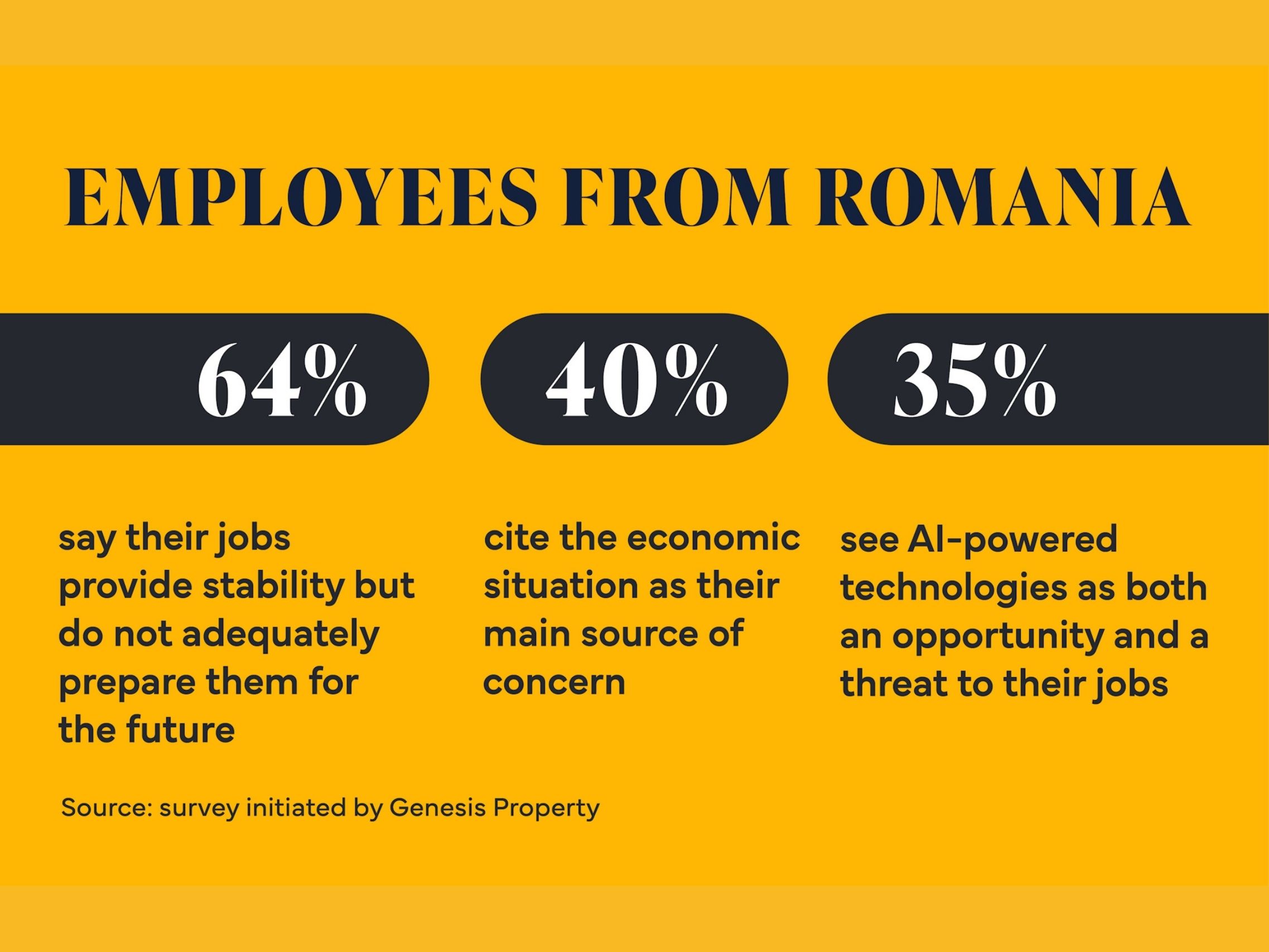
Job security is no longer built solely around having a stable role, but increasingly around people’s ability to learn, adapt and remain relevant in an economy being reshaped by artificial intelligence. More than 60% of employees say their current role primarily provides stability, without offering sufficient opportunities for development, or even leaves them feeling stuck. At the same time, only 14% feel completely secure in their jobs and confident about their career prospects, while half consider themselves relatively secure but are closely monitoring changes within their company and across the wider market, according to a Genesis Property survey conducted among a nationwide sample of 1,026 respondents.
This combination of stability and the need to adapt is also reflected in how employees describe their current career path. Nearly 47% say they are in a period with no major changes, while more than 21% are focused on learning and adapting to keep pace with shifts in the market. Only around 13% consider themselves to be in a clear phase of growth and development, suggesting that, for many, the current priority is to remain professionally relevant rather than accelerate their career progression.
“Job security is no longer defined solely by the stability of a role, but by people’s ability to remain relevant in a rapidly changing economic and social environment. Economic pressures, the transformation of job roles and advances in artificial intelligence are prompting employees to seek more than continuity: they want genuine opportunities to learn, adapt and progress. In this context, organisations need to create environments that not only support today’s performance, but also prepare people for what lies ahead. The office can become an important part of this process, a space for collaboration, the exchange of ideas, learning and professional development, capable of supporting people’s transformation and strengthening companies’ resilience”, said Teodor Stoica, HR Manager, Genesis Property.

The labour market is becoming increasingly challenging, as economic pressures are translating more visibly into stagnant incomes, heavier workloads and efficiency measures. Nearly 24% of employees report salary stagnation or significantly smaller pay rises than in previous years, more than 18% are experiencing an increase in workload, while around 12% have observed cost-optimisation measures within their organisations.
Job insecurity is driven primarily by the economic environment and its potential impact on companies. More than 40% of employees identify the state of the economy as their main source of concern, around 26% fear restructuring or redundancies, while nearly 11% point to a lack of professional development opportunities.
Job security continues to be associated primarily with financial stability, but is increasingly encompassing opportunities for development and adaptability. One-third of employees define it as having a stable income over the medium to long term, nearly 19% as working for a financially sound employer, and 11% as having access to genuine professional development opportunities.
Adaptability and new skills are becoming essential in a changing labour market
Professional relevance is increasingly linked to people’s ability to learn, integrate technology and collaborate effectively. More than 19% of employees believe they need to prioritise developing adaptability and continuous learning skills, nearly 14% point to the use of AI, while more than 12% emphasise communication and collaboration.
At the same time, preparedness for the impact of AI is increasing, but remains uneven and is still marked by uncertainty. More than 32% of employees have begun developing the skills they need, nearly 28% already use AI in their work, while around 27% recognise that the technology will transform their roles but do not yet know exactly how to prepare.
Perceptions of AI remain balanced rather than polarised, with many employees recognising both its potential and its risks. Nearly 35% view AI as both an opportunity and a threat, 34% see it primarily as an opportunity, while more than 22% do not expect it to have a significant impact on their own job.
Building on the expectations of younger generations and the transformations reshaping the labour market, Genesis Property is developing more than office buildings: it is creating workplace ecosystems that support performance, professional growth and employees’ personal wellbeing. YUNITY Park, the office campus owned by Liviu Tudor, founder of Genesis Property, brings this vision to life through extensive green spaces, relaxation areas and amenities designed to promote wellbeing and interaction. The project is currently in its third phase of development, with total investment in the transformation of the campus reaching €50 million.
The Genesis Property survey on job security in 2026 was conducted online in July among a total sample of 1,026 internet users in Romania. More than 54% of respondents were men, 16% were business owners, shareholders or held management positions, while over 31% reported a net monthly income of more than 6,000 lei.
—————-
About Genesis Property
Genesis Property is one of Romania’s leading developers and operators of Class A office buildings, with more than 20 years of experience. The company owns and manages two major business campuses in Bucharest – YUNITY Park and West Gate Business District – with a total GLA of over 150,000 sqm and more than 15,000 employees working within them.
Its portfolio includes companies such as HP Inc., Hewlett Packard Enterprise, Accenture, Ericsson, Garanti BBVA, Siemens, Infineon, Luxoft and Yokogawa România. Genesis Property is also the developer of West Gate Studios, the largest private student campus in Romania.
For more information, visit GenesisProperty.net


