OP-ED #12 · Liviu Tudor, President and Founder of Genesis Property
How workspaces are transforming from places of production into places of human evolution – and why Yunity is the first real prototype of this transformation
In previous articles, we explored three fundamental realities:
- The Age of Becoming changes the nature of economic value: it is no longer output, but the evolution of the individual.
- The organizations of the future become ecosystems of becoming, not systems of production.
- KBIs (Key Becoming Indicators) become the new organizational currency.
But the essential question immediately appears:
Where does this becoming take place?
In what type of space?
In what infrastructure?
In what physical and mental architecture?
The office, as we know it, cannot support this transition.
It was built for efficiency, not for evolution.
For standardization, not for talent.
For control, not for creativity.
That is why a new concept emerges – necessary, not optional:
The Becomator
The first space dedicated not to work, but to human becoming.
It is the fundamental infrastructure of the Age of Becoming.
Just as factories defined the Industrial Age,
and offices defined the Knowledge Work Age,
Becomators will define the Age of Becoming.
1. Why we need a completely new infrastructure for human evolution
Traditional work needed:
- offices,
- factories,
- processes,
- hierarchies,
- procedures.
But becoming needs:
- freedom,
- exploration,
- talent development,
- creative context,
- human + AI mentorship,
- community,
- identity,
- meaning.
No space in today’s world offers all these elements simultaneously.
Becoming cannot take place in:
- traditional offices,
- meeting rooms,
- coworking spaces,
- training rooms,
- corporate spaces “beautifully designed.”
All of these are spaces of production.
The Becomator is the space of evolution.
2. The structural limits of the traditional office
The office was designed for:
- visible control,
- formal communication,
- repetitive processes,
- predictability,
- efficiency measured through KPIs.
That is why the office:
- inhibits exploration,
- reduces creative flow,
- minimizes autonomy,
- discourages vulnerability,
- accentuates ego,
- amplifies pressure.
The office is, by design, a system of cognitive production.
The Age of Becoming requires a system of human evolution.
3. The fundamental principles of a Becomator
The Becomator is built on seven pillars:
1. Alignment with natural talent
Every activity must support the discovery and practice of authentic predispositions.
2. Free exploration, without pressure
No “must deliver,” no KPIs, no hierarchies – only testing, curiosity, prototyping.
3. Hybrid mentorship: human + AI
AI becomes:
- a cognitive mirror,
- a creative accelerator,
- a personalized coach,
- an architect of becoming pathways.
4. Autonomy in rhythm and choices
Each person evolves differently. The Becomator respects natural rhythms.
5. A community of evolution, not competition
Value is created through collaboration, not comparison.
6. Physical space that induces creativity
Light, natural materials, fluid zones, spaces for deep focus and free expression.
7. Personal identity in transformation
The Becomator is not a place where you come “as an employee.”
It is the place where you come as a person who is becoming.
4. The Becomator as economic infrastructure, not as an amenity
The Becomator is not:
- a creative room,
- a lounge,
- a beautiful café,
- a premium coworking space,
- a place “with vibe.”
It is economic infrastructure for the future of human productivity.
For companies, the Becomator becomes:
- an innovation center,
- an ideas laboratory,
- a talent accelerator,
- an autonomy incubator,
- a retention space,
- a competitive differentiator.
For cities, it becomes:
- public infrastructure for creativity,
- a magnet for emerging industries,
- a mechanism for urban regeneration.
At a societal level, it becomes:
the foundation for an economy centered on potential, not effort.
5. The role of AI in the functioning of a Becomator
Without AI, the Becomator cannot exist.
AI provides:
1) Potential measurement (KBIs)
It identifies cognitive rhythms, talents, natural predispositions.
2) Total personalization
Each person has their own unique path.
3) Immediate feedback, without judgment
No shame, no competition, no pressure.
4) Co-creation
Human + AI become a creative duo.
5) Permanent virtual mentorship
Available 24/7, adaptable, intelligent.
AI transforms becoming from intuition into a systemic process.
6. Impact on people
The Becomator:
- reduces anxiety,
- eliminates status pressure,
- dissolves ego,
- restores meaning,
- increases internal energy,
- activates real talent,
- stimulates creativity,
- creates the feeling that “I am in the right place.”
People no longer come to work.
They come to become.
7. Impact on organizations
Organizations that integrate Becomators:
- attract high-potential people,
- retain hard-to-replace talent,
- generate new ideas constantly,
- reduce burnout,
- increase autonomy,
- become a magnet for younger generations,
- transform their culture from within.
Performance becomes a natural consequence of human evolution.
8. Why the Becomator will become the urban standard
The cities of the future will have:
- libraries for the mind,
- halls for the body,
- spaces for creativity,
- laboratories for prototyping.
Becomators are the new cultural centers of the AI Age.
They will be as natural as schools in the Industrial Age and offices in the Information Age.Informației.
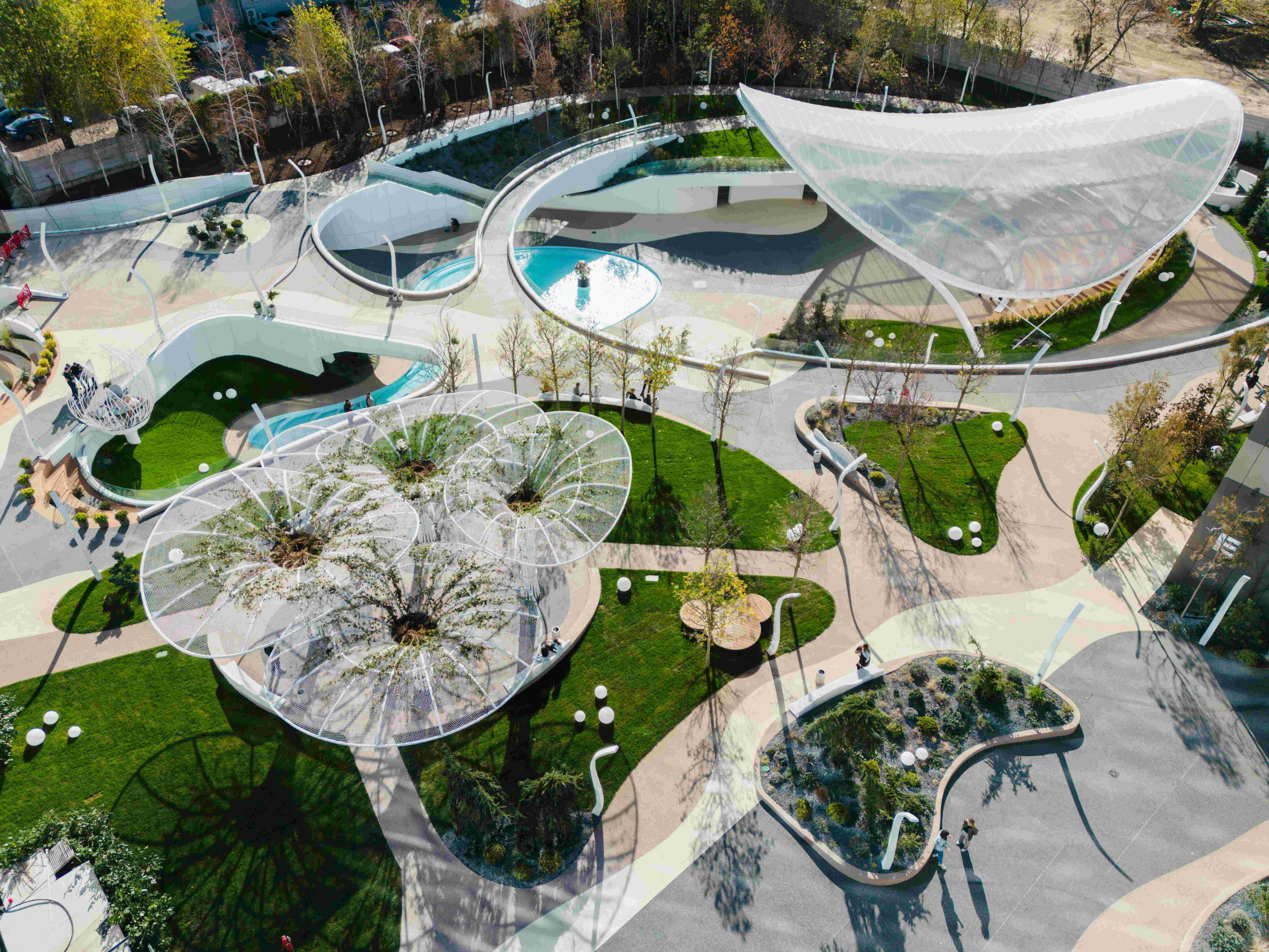
9. Yunity: the first real prototype of becoming infrastructure
Yunity is the first place where:
- a culture of becoming,
- experience architecture,
- physical infrastructure,
- AI,
- art,
- community,
- a professional way of life
combine into a coherent system.
Yunity:
- is not an office park,
- is not a coworking space,
- is not a wellness space,
- is not a training hub.
It is the first real ecosystem of the Age of Becoming.
The place where people:
- work as in the Age of the Office,
- evolve as in the Age of Becoming.
The transition begins here.
10. Conclusion: the future of work is not work. It is becoming.
Offices belonged to an age that is fading.
Becomators belong to the age that is beginning.
Yunity is proof that this age is not a philosophical concept,
but a reality under construction.
The organizations, cities, and societies of the future will be defined not by infrastructures of production,
but by infrastructures of becoming.
In the Age of Becoming, the highest value is not what you create,
but who you become.
Note: This article was produced with the assistance of artificial intelligence tools, which were used to structure and refine the content. The ideas and editorial responsibility belong to the author.


